
If you’re getting a design ready for jewelry casting, the biggest decision after the CAD model is finished is what to print the casting pattern in: castable wax or castable resin. Both are made to burn out of an investment mold and leave behind a clean cavity for molten metal, but they behave very differently in the kiln, hold detail differently, and cost different amounts. Our Glendale studio prints both nearly every day for jewelers, designers, and casting houses across Los Angeles, so here’s a practical guide to choosing the right one for your piece.
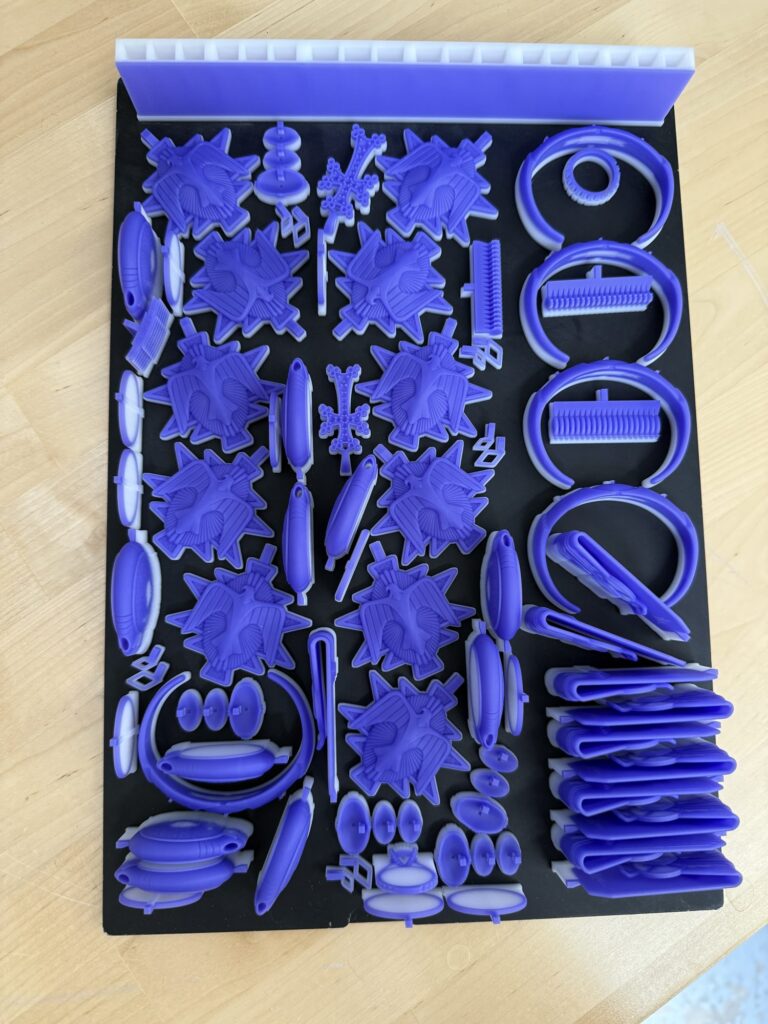
How Pattern Material Affects Jewelry Casting
Every lost-wax casting job starts with a pattern — a physical copy of your ring, pendant, or setting. The pattern gets invested in a plaster-like mold, the mold goes into a burnout kiln, and the pattern melts or vaporizes away so metal can take its place. If the pattern burns out cleanly, you get crisp prongs, sharp milgrain, and smooth surfaces. If it leaves ash or expands too aggressively, you get porosity, cracked molds, and lost detail. That’s why the choice of pattern material matters just as much as the CAD work that comes before it.
Castable Wax: The Cleanest Burnout for Fine Detail
Dedicated wax 3D printers build patterns from real wax, the same family of material jewelers have cast for generations. Wax melts out at low temperatures and burns away with virtually no ash, which makes it very forgiving during burnout and gentle on investment molds. It also holds extremely fine features — thin filigree, delicate prong tips, tight pavé layouts — better than almost anything else.
The tradeoff is fragility. Wax patterns are soft, so they need careful handling and aren’t ideal for parts with long, thin, unsupported spans that must survive shipping or repeated handling. Wax printing also tends to cost more per piece than resin printing.
Castable Resin: Tough Patterns at a Lower Cost
Castable resins are photopolymers printed on SLA or DLP machines and formulated to burn out of investment. Resin patterns are far more durable than wax — you can clean them up, try them on, ship them, and set them in sprue trees without worrying about snapped prongs. Per piece, resin printing is usually the more economical option, especially for larger or heavier designs like signet rings, cuffs, and belt buckles.
The tradeoff is that resin demands a proper burnout schedule. It needs higher temperatures and a slower ramp than wax, and a rushed burnout can leave ash or stress the mold. With a casting partner who runs resin regularly, modern castable resins produce excellent results.
Which Should You Choose for Your Jewelry Casting Project?
As a rule of thumb, we steer clients this way: choose castable wax for high-end pieces with micro detail — pavé and micro-prong settings, filigree, engraved textures, and anything where surface quality straight out of casting matters most. Choose castable resin for bolder geometry, chunkier rings, pendants, and production runs where durability and cost per pattern matter more than the last fraction of detail.
Many of our jewelry clients use both: resin for fit-check prototypes and wax for the final casting pattern.
What Does It Cost in Los Angeles?
Pricing depends on volume, detail, and quantity. As a general range, small resin casting patterns often land in the low tens of dollars per piece, while wax patterns typically run moderately higher because of machine and material costs. Ordering multiple patterns in one build brings the per-piece price down noticeably. We’re happy to quote both options side by side so you can compare.
Beyond printing, our jewelry services at https://ecadcam.com/jewelry-services/ cover jewelry CAD design, wax and castable resin printing, and support through lost-wax casting, while our 3D printing department at https://ecadcam.com/3d-printing/ handles prototypes in other materials when you want to test a design first.
Not sure which route fits your piece? Send us your CAD file or even a sketch. eCadCam has served Los Angeles jewelers for over two decades from our Glendale studio at 4212 San Fernando Rd. Request a quote today or call 213.489.1173 and we’ll help you get from model to metal.